What a capacitor does
The capacitor is a small cylinder that gives your AC’s motors the jolt they need to start and the steady push to keep running. It’s a simple, inexpensive part — but when it weakens, the whole system struggles to start, runs hot, or quits altogether, usually right when you need cooling most.
Signs of a weak or failing capacitor
Classic symptoms: the outdoor unit hums but won’t start, the fan needs a nudge to spin, the AC trips the breaker, or it blows warm air because the compressor can’t get going. Often, though, a fading capacitor gives no obvious warning at all — the system still blows air, it’s just quietly straining. You can’t tell by looking; the only way to know for sure is to measure it.
How we test it
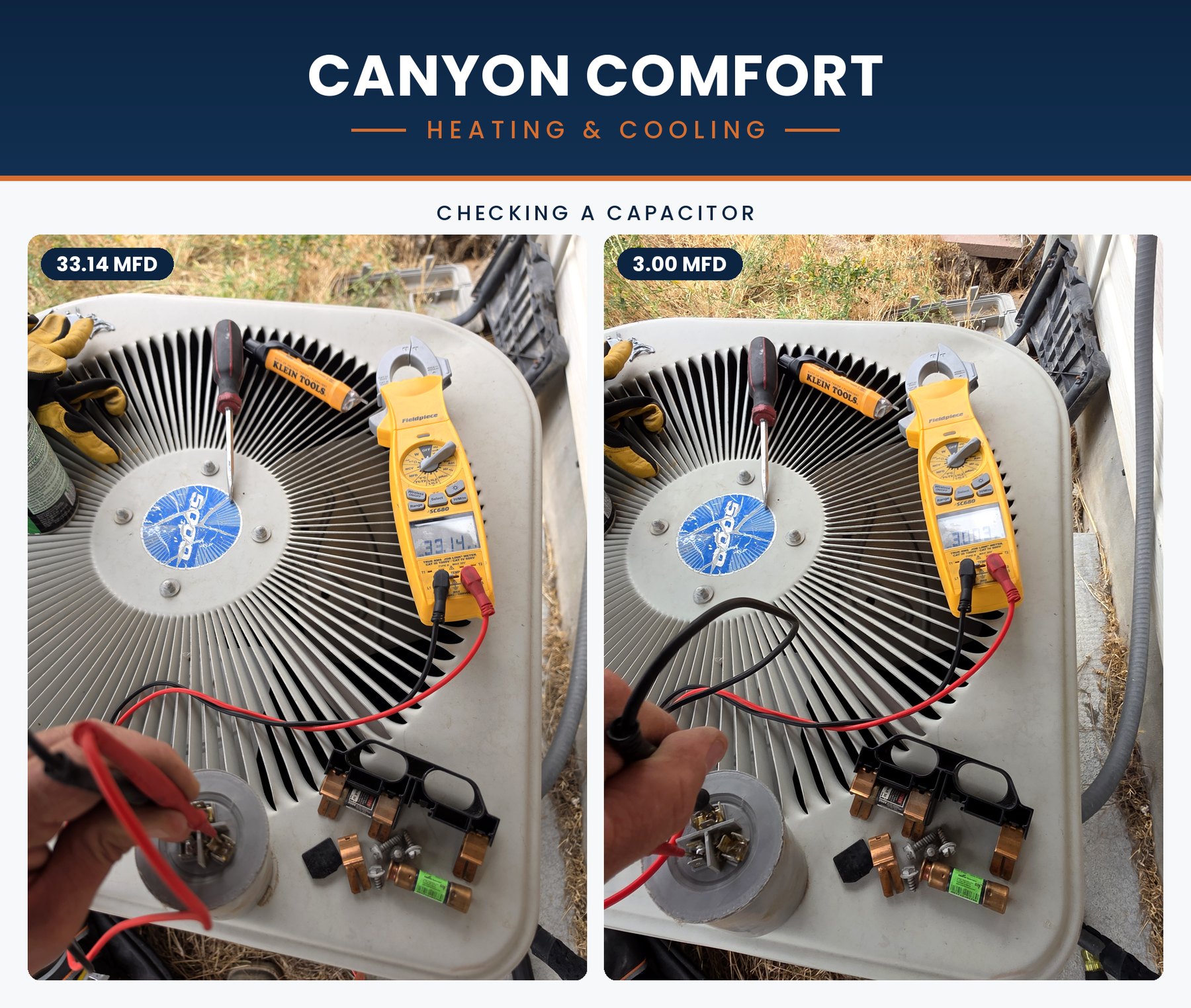
We measure the capacitor with a meter and compare each side to its printed rating in microfarads (µF, sometimes marked MFD). A dual run capacitor carries two ratings — one for the compressor and one for the fan, so you’ll see something like 35/5 — and a healthy one reads within a few percent of each. If a side has dropped well below its rating, that part is weakening and on its way out, even if the AC is still running for now.
Why a weak capacitor is worth catching early
Here’s the part that costs people money. When the capacitor weakens, the motor still tries to run — so it draws more current, runs hotter, and works harder on every single start. Do that thousands of times over a hot Utah summer and that heat slowly cooks the motor’s windings. Now a small, cheap part has taken out a blower motor or compressor — a far bigger, far pricier repair. Replacing a fading capacitor before it strains the motor is one of the cheapest ways to protect the expensive parts of your system.
It’s not just the capacitor
The same “small part, big consequence” pattern shows up all over an HVAC system, which is why a good maintenance visit checks more than one thing:
- A pitted contactor (the relay that switches your outdoor unit on) arcs and overheats until it welds shut or won’t close.
- A dirty filter or coil chokes airflow, so the blower motor overheats and the AC coil can freeze.
- Low refrigerant from a small leak makes the compressor run hot and starved — the fastest way to lose the priciest part in the system.
- A worn blower wheel or dry motor bearings drag down airflow and efficiency long before they seize.
Don’t guess — test it
If your AC won’t start or keeps tripping the breaker, the capacitor is one of the first things worth checking — but it shouldn’t be the only thing. The contactor, the wiring, the motor, and the rest of the electrical all get tested too, so a weak part doesn’t get missed and nobody’s just throwing parts at the problem.
And if the part has to be ordered in the middle of a heat wave, you can rent a portable air conditioner from us to keep the house livable until the repair is done.
Get a straight answer
Tell us what’s going on and we’ll measure what’s strong, flag what’s fading, and give you clear options and a straight, expert answer.