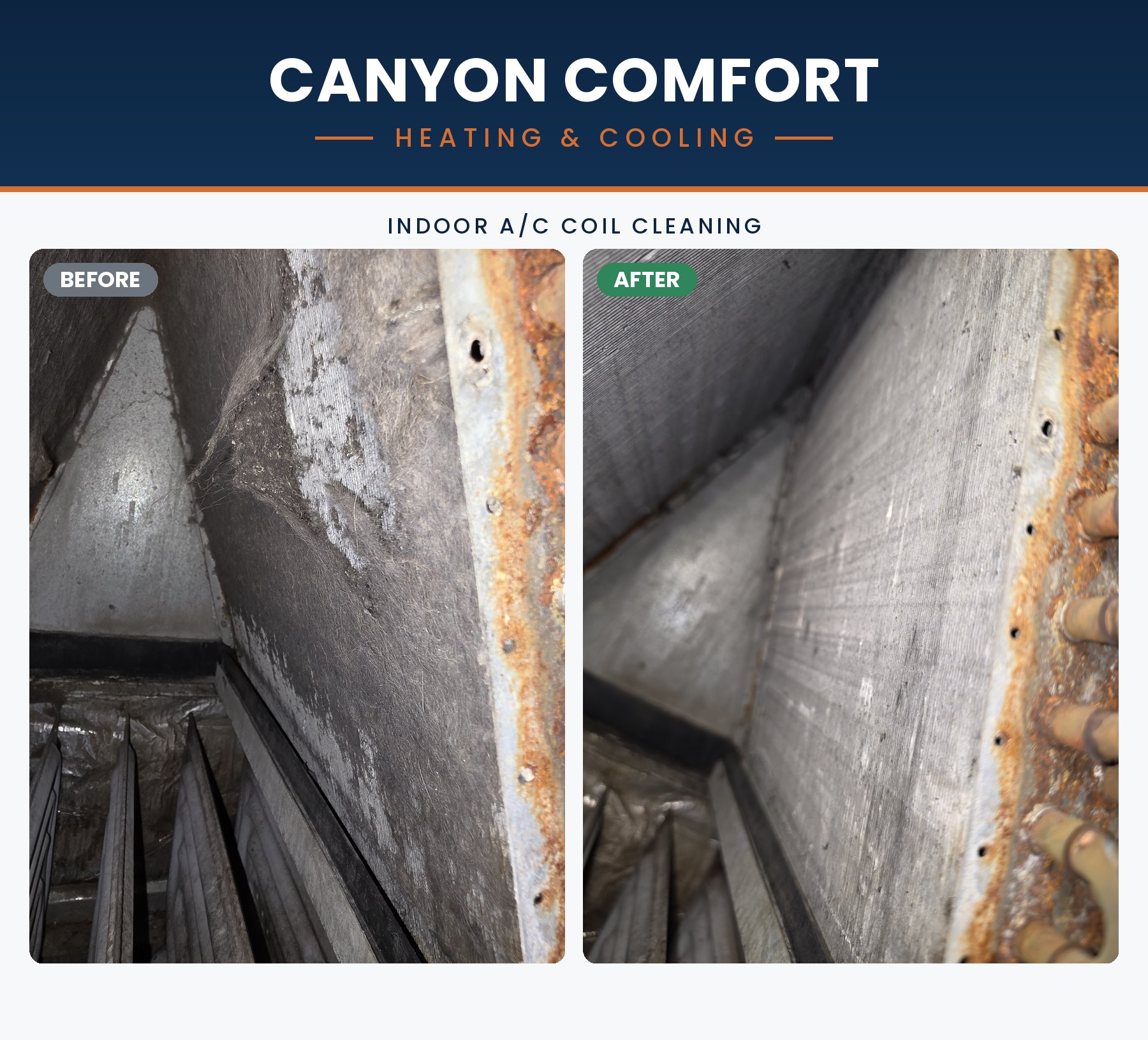
Your evaporator coil: where your cool air actually comes from
The evaporator coil sits on top of your furnace (or inside your air handler), right above the blower. Your AC's refrigerant runs through it, and the warm air from your home blows across it — that's the moment your air actually gets cooled. Because every bit of air in your house passes over that coil, it slowly collects dust, pet hair, and the fine grit Utah's dry air is known for.
As that film builds up, three things happen:
- Airflow drops. A dirty coil is like breathing through a scarf — your blower has to work harder to push air through it.
- Cooling gets weaker. The grime insulates the coil, so it can't pull heat out of your air. Rooms stay warm even though the system runs nonstop.
- The coil can freeze. Restricted airflow can drop the coil below freezing and ice it over — now you get no cooling, water when it melts, and a compressor under serious strain.
A dirty or frozen evaporator coil also puts the compressor — the most expensive part of your AC — at real risk. When airflow is choked, the coil can't boil the refrigerant off the way it should, and liquid can slug back to the compressor — something it isn't built to take. Run it that way long enough and a good compressor can fail years early, all because the coil never got cleaned.
The secondary heat exchanger: small problem, big (and dangerous) consequences
If you have a 90%+ high-efficiency furnace, it has a secondary heat exchanger — extra passages that pull so much heat out of the exhaust that the gases cool and condense into water (that's why these are called "condensing" furnaces). Recovering that extra heat is what makes them efficient — but the condensate they produce is mildly acidic, so over the years that section can collect residue and corrode if it's never cleaned or inspected.
When a secondary heat exchanger clogs or corrodes:
- The furnace can't move heat efficiently, so your gas bill creeps up.
- The system can overheat and trip its safety limits — short-cycling on and off, never really warming the house.
- If it cracks or badly corrodes, combustion gases (including carbon monoxide) can leak into your air. That's why we inspect it closely on every tune-up.
Why Utah homes are especially hard on these parts
Our valley runs your system hard in both directions — brutal July heat and deep January cold — and the dust and winter inversions load up coils and filters faster than a milder climate would. That's why a system that feels "fine" can be silently losing efficiency every season.
What you can do
A few things are DIY-friendly: change your filter on schedule (a clean filter is the cheapest protection your coil has), keep the outdoor unit clear of cottonwood, grass clippings, and debris, and gently rinse the outdoor coil fins with a hose.
The evaporator coil and heat exchanger, though, live inside the sealed cabinet and around the burners — cleaning them properly takes the right tools, coil-safe cleaners, and a careful eye for cracks and corrosion. That's part of what we check on a maintenance visit, along with a close look at that heat exchanger for your family's safety. When they need a deep cleaning, we quote it separately.
Not sure when yours was last cleaned?
Call or book online and we'll inspect both and tell you whether either needs cleaning.
Got an HVAC question?
Ask it on the online quote page: a real answer, a second opinion, or a firm quote, whichever you need.